
Reference hazards: Flammable liquid. Published reference classifications include acute toxicity through skin contact and inhalation, harmful effects on ingestion, and severe skin and eye injury. Reference signal word: Danger.
Handling: Use effective ventilation, control ignition sources and static discharge, and prevent vapor exposure and skin or eye contact. Select protective gloves, clothing, eye and face protection, and any respiratory protection according to the current SDS and workplace assessment.
Storage: Keep containers tightly closed in a cool, dry, well-ventilated location, separated from incompatible materials as specified in the current product SDS.
Transport and documentation: Obtain the applicable SDS and transport classification before shipment. A single UN number, hazard class, or packing group is not assigned here because published references differ. Confirm the requirements for the actual grade, transport mode, and destination.
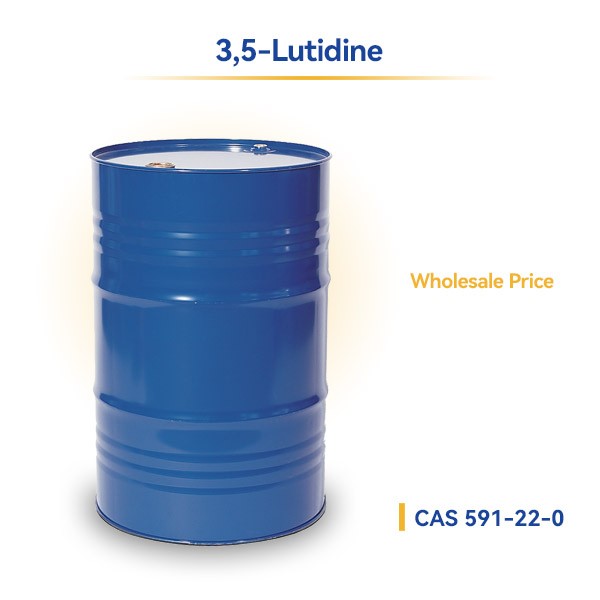
3,5-Lutidine CAS 591-22-0
Aure Chemical: Your Reliable Source for High-Purity 3,5-Lutidine (CAS 591-22-0)
3,5-Lutidine (3,5-dimethylpyridine), CAS 591-22-0, is a substituted pyridine with methyl groups at positions 3 and 5 relative to the ring nitrogen. Its basic nitrogen and substituted aromatic ring make it useful as a building block in selected pharmaceutical intermediate, agrochemical, and fine chemical synthesis routes, and as a nitrogen-donor ligand in coordination chemistry research. Aure Chemical supports China sourcing, specification review, and international export coordination for this product.
Basic Information of 3,5-Lutidine
The following identity and physical properties are general references for 3,5-lutidine. Physical properties are not batch acceptance criteria. The reference COA reports assay and water only; its specifications and results are shown separately below.
| CAS No.: | 591-22-0 |
|---|---|
| EC No.: | 209-708-6 |
| Molecular Formula: | C₇H₉N |
| Molecular Weight: | 107.15 g/mol |
| Appearance: | Colorless to pale yellow clear liquid (general reference; not reported in the reference COA) |
| Melting Point: | −9 °C (literature reference) |
| Boiling Point: | 169–170 °C (literature reference) |
| Density: | 0.939 g/mL at 25 °C (literature reference) |
| Water Solubility: | 33 g/L at 20 °C (literature reference) |
| Flash Point: | 47 °C, closed cup (published reference value; confirm the applicable product SDS) |
| Chemical Type: | Dimethyl-substituted pyridine; nitrogen-containing heterocyclic base |
| Transport Classification: | Confirm the UN number, proper shipping name, hazard class, subsidiary risks, and packing group using the current SDS and transport classification for the supplied grade. |
| Chemical Structure: | 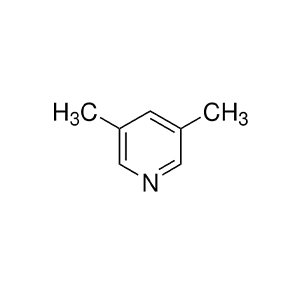 |
Reference Quality Analysis
Assay and water content provide an initial basis for evaluating 3,5-lutidine as a synthesis intermediate. The following table separates the reported acceptance limits from the results of one reference batch. It does not provide a profile of individual lutidine isomers or other impurities.
| Test Item | Reported Specification | Reference Result |
|---|---|---|
| Assay (%) | ≥99.0 | 99.63 |
| Water (%) | ≤0.2 | 0.03 |
The report identifies a company standard without giving a standard number or analytical methods. Percentages are reproduced as reported; the percentage basis is not specified. Buyers requiring a particular assay method, water determination method, or impurity limit should agree these requirements before ordering.
These analytical values are provided for preliminary technical evaluation and should not be interpreted as guaranteed specifications for every shipment. Confirm the applicable quality requirements and request the relevant batch-specific Certificate of Analysis (COA) from Aure Chemical before ordering.
Primary Applications of 3,5-Lutidine (3,5-Dimethylpyridine)
The 3,5-substitution pattern distinguishes this product from other lutidine isomers. Application selection should be based on the required molecular structure and process conditions.
Pharmaceutical intermediate synthesis: Used as a substituted pyridine building block in selected synthesis routes. Suitability for a specific intermediate depends on the target structure and analytical requirements; the reference COA does not establish a pharmaceutical or compendial grade.
Agrochemical and fine chemical intermediates: Used in selected routes to pyridine-containing intermediates. Confirm the required isomer identity, assay, water content, and any process-specific impurity limits rather than treating different dimethylpyridine isomers as interchangeable.
Organic synthesis reagent: The pyridine nitrogen can participate in acid–base chemistry and further derivatization. Its suitability as a base or intermediate must be evaluated for the individual reaction; it should not automatically be substituted for 2,6-lutidine or another pyridine reagent.
Coordination chemistry research: Acts as a nitrogen-donor ligand in characterized transition-metal complexes. Published examples include manganese, cobalt, nickel, and zinc sulfate complexes containing coordinated 3,5-lutidine. Such research use does not establish commercial catalytic performance.
Why Choose Aure Chemical for Your 3,5-Lutidine Supply?
Aure Chemical is a chemical sourcing, trading, and export supply company. We coordinate product specifications and documentation with suppliers to support buyers evaluating 3,5-lutidine for synthesis and process development.
Product identity and specification review: Review CAS identity, assay, water content, and any additional impurity requirements. Individual isomer limits and related-substance data should be confirmed separately when needed.
Quality documentation: Coordinate the applicable batch COA and current product SDS. Additional testing and method requirements are subject to supplier confirmation and agreement before purchase.
Supplier coordination: Confirm available quantity, grade, packaging, and lead time for the proposed order. The displayed batch results are technical references rather than a guarantee of future batch results.
Export and logistics coordination: Review packaging, labeling, documentation, and shipment feasibility according to the actual product classification, destination, and transport mode.
Safety, Handling & Documentation
Published safety references for 3,5-lutidine differ in some hazard and transport classifications. The summary and pictograms below are a reference for the neat substance; final labeling, handling, and shipping requirements must follow the current SDS for the supplied grade.



Packaging
200 L steel drum
Final packaging, capacity and net weight are confirmed in the quotation and order.