

Innovative Pathways in Photocatalytic Hydrogen Generation
The Strategic Role of Photocatalytic Technologies in Hydrogen Economy
Photocatalytic water splitting emerges as a cornerstone in the transition toward sustainable hydrogen production, leveraging abundant solar energy and water resources to generate clean fuel without fossil inputs. This approach addresses key challenges in the energy sector, including decarbonization of industrial processes and enhancement of energy security in sun-rich geographies. By converting sunlight directly into chemical energy, it offers a pathway to low-emission hydrogen that complements electrolysis and reforming methods, particularly in applications requiring high-purity outputs for fuel cells, refining, and chemical synthesis.
In regions with ample solar irradiance, such as southwestern China, these technologies enable localized production hubs that minimize transportation costs and integrate with existing infrastructure. The focus on composite catalysts derived from earth-abundant materials further supports economic viability, positioning photocatalytic systems as a scalable alternative for global hydrogen markets projected to expand amid net-zero ambitions.
Core Innovations in Catalyst Design and System Integration
At the heart of efficient photocatalytic hydrogen generation lies the development of advanced materials like polyhedral strontium titanate, which exhibits unique photoelectric properties for broadband light absorption and charge separation. Research efforts spanning over a decade have yielded multifaceted structures, including 18-sided, 26-sided, and hollow cage configurations, optimized since 2019 to enhance quantum efficiency and expand spectral response.
These catalysts facilitate zoned reactions within sealed vessels, where concentrated solar flux drives the dissociation of water into hydrogen and oxygen streams. Purity levels reaching 99.8% for hydrogen and 98.6% for oxygen underscore the precision of this interface engineering, achieved through composite formulations that regulate crystal facets and electron transfer pathways. Such designs not only boost conversion rates but also enable multifunctional outputs, incorporating electric and thermal co-products for comprehensive energy utilization.
System architectures incorporate spectral splitting and filtering optics to harness ultraviolet and visible wavelengths selectively, marking a shift toward full-spectrum solar exploitation. This integration within a single process unit represents a leap in operational simplicity, reducing complexity compared to traditional multi-stage setups and aligning with industrial-scale chemical production paradigms.
Operational Frameworks for Commercial-Scale Deployment
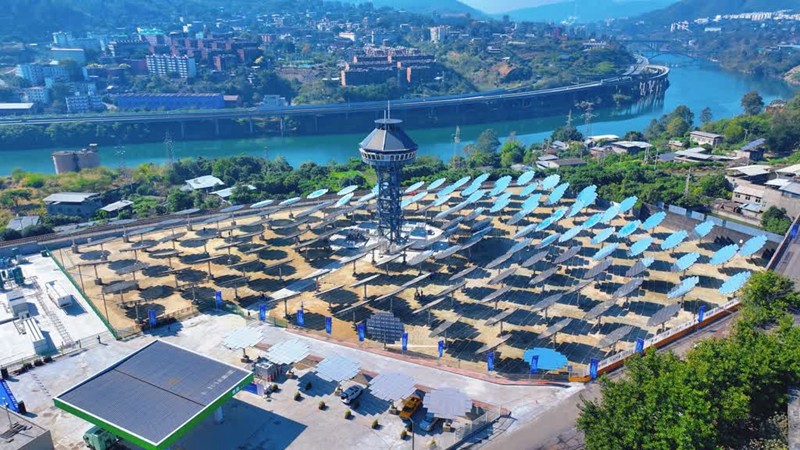
Large-scale facilities exemplify the practical application of these technologies, with installations covering approximately 33 acres and dedicated hydrogen zones spanning 21 acres. Initial capital outlays around 60 million RMB, including 30 million RMB for core equipment, support modular designs featuring arrays of heliostats—typically 144 units—and reaction chambers, such as 24 specialized reactors.
Current operational capacities deliver up to 200 tons of hydrogen annually, with pathways to 300 tons through incremental expansions in tracking mirrors and reactor modules. Post-reaction processing involves cooling and dehydration to prepare hydrogen for storage, ensuring seamless integration with downstream applications like refueling stations. These setups demonstrate robust performance in real-world conditions, validating the transition from laboratory prototypes to industrialized workflows.
Economic modeling targets production costs at 21 RMB per kilogram in optimized phases, descending to 16 RMB per kilogram at full capacity, driven by efficiencies exceeding 20% in light-to-hydrogen conversion. This cost trajectory enhances competitiveness against gray hydrogen, particularly in high-sunlight locales where free solar input offsets energy expenses.
Future Horizons and Scalability in Solar Hydrogen Production
Looking ahead, the evolution of photocatalytic systems emphasizes process refinement for higher throughputs, with ambitions for 10,000-ton-per-year bases commencing construction in strategic timelines around 2026. Emphasis on one-time build-and-commission models prioritizes streamlined engineering, full-process monitoring, and performance benchmarking to achieve immediate operational targets.
Key differentiators include maximized solar utilization rates, superior reactor productivity per unit volume, and elevated apparent quantum efficiencies, all contributing to the lowest green hydrogen costs in class. Extending these innovations involves upgrading to comprehensive light-hydrogen-oxygen-electric-heat paradigms, where entire solar spectra are channeled into unified equipment for multi-output generation.
Urban centers with strong solar profiles stand to benefit as demonstration sites, fostering ecosystems that attract investment in renewable infrastructure. This scalability not only bolsters domestic energy resilience but also positions such technologies for export, aiding international efforts in hydrogen infrastructure development across automotive, aviation, and heavy industry sectors.
Ultimately, these advancements in photocatalytic hydrogen underscore a maturing field where material science converges with engineering to deliver resilient, eco-friendly energy solutions, empowering stakeholders to navigate the complexities of a low-carbon future.