
Zinc Triflate CAS 54010-75-2
Aure Chemical: Your Trusted Source for High-Purity Zinc Triflate (CAS 54010-75-2)
Zinc Triflate, also known as Zinc(II) Trifluoromethanesulfonate or Zn(OTf)₂, is the zinc salt of trifluoromethanesulfonic acid, CAS No. 54010-75-2. It combines a Zn²⁺ cation with two triflate anions and is used as a Lewis acid in selected organic synthesis reactions. It has also been investigated in polymerization systems and zinc battery electrolytes.
Aure Chemical supports China chemical sourcing and export supply of Zinc Triflate. The reference quality analysis below covers a reported ≥98% grade, with appearance and purity results for preliminary technical evaluation. Requirements for water content, impurities, and intended application should be agreed before ordering.
Basic Information of Zinc Triflate
Product identity and general properties are listed below. The reference report specifies a white to light gray powder; it does not establish an anhydrous, battery, or other application-specific grade.
| CAS No.: | 54010-75-2 |
|---|---|
| EC No.: | 258-922-6 |
| Condensed Formula: | Zn(CF₃SO₃)₂ |
| Molecular Weight: | 363.53 g/mol |
| Appearance Specification: | White to light gray powder |
| Solubility: | Soluble in water; general reference property. |
| Moisture Sensitivity: | Hygroscopic. Follow the current product SDS and confirmed storage instructions. |
| Reported Purity Specification: | ≥98%; see Reference Quality Analysis. |
| Chemical Structure: | 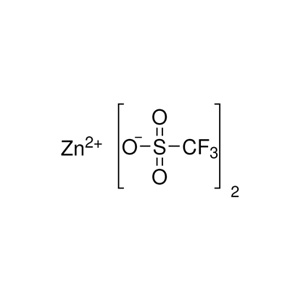 |
Reference Quality Analysis
The following appearance and purity parameters provide a technical reference for evaluating Zinc Triflate for synthesis applications. The reported appearance result confirms compliance with the stated color and powder specification; purity is reported separately as a numerical result.
| Test Item | Reported Specification | Reference Result |
|---|---|---|
| Appearance | White to light gray powder | Conform |
| Purity | ≥98% | 98.42% |
The report does not specify the purity test method or calculation basis, and provides no water content or impurity profile. For moisture-sensitive catalysis or electrolyte development, confirm the required analytical method, water limit, and relevant impurity limits separately.
These results represent one production lot and are provided for preliminary technical evaluation. They are not guaranteed specifications for every shipment. Please contact Aure Chemical to agree the applicable quality requirements and request the relevant batch-specific Certificate of Analysis (COA) before ordering.
Primary Applications of Zinc Triflate (Zinc(II) Trifluoromethanesulfonate)
Zinc Triflate is selected according to its Lewis acid behavior and compatibility with the reaction medium. Catalyst loading, substrates, solvent, and moisture content influence its suitability; performance requires evaluation in the intended process.
Lewis Acid in Organic Synthesis: Used in selected aldol and nucleophilic addition reactions. Coordination to reactive functional groups can assist substrate activation, with the outcome depending on the reaction conditions.
Protecting Group Chemistry: Documented uses include thioketal formation and selective removal of triethylsilyl (TES) protecting groups. These applications require the appropriate substrates and conditions rather than a general assumption that all protecting groups behave similarly.
Polymerization Research: Investigated as a component of Lewis acid-based polymerization systems, including combinations with phosphine co-catalysts. Monomer selection, catalyst composition, and moisture control must be established for the chosen system.
Fine Chemical and Intermediate Synthesis: May be evaluated in selected pharmaceutical and agrochemical intermediate routes that use zinc-mediated Lewis acid chemistry. Suitability depends on process validation and agreed impurity requirements; the reference report does not establish pharmaceutical grade.
Zinc Battery Electrolyte Research: Studied as a zinc salt in aqueous and mixed-solvent electrolyte formulations. Electrochemical behavior depends on the complete formulation. The appearance and purity data above alone do not establish battery grade or electrolyte performance.
Use in an aqueous reaction or electrolyte does not establish stability under all conditions. Water compatibility and drying requirements should be assessed for the specific process.
Its catalytic behavior is discussed in metal triflates as Lewis acid catalysts in organic synthesis.
For a broader view of metal triflates within triflate chemistry, refer to the overview of triflic acid and triflate chemistry.
Why Choose Aure Chemical for Your Zinc Triflate Supply?
Aure Chemical is a chemical trading and export supply company. We coordinate product sourcing, specification review, and documentation for Zinc Triflate procurement.
Specification Review: We review the requested purity, appearance, moisture limits, and application requirements against available product information. Additional testing and alternative grades require separate confirmation.
Quality Documentation: We coordinate requests for the applicable COA, SDS, and clarification of analytical methods or reporting basis where needed.
Supplier Coordination: Availability, packaging, and lead time are checked against the required quantity and agreed specification before an order is confirmed.
Packaging Review: Container closure and protection from moisture are reviewed with the supplier according to product requirements, order size, and transport conditions.
International Export Logistics: We coordinate shipment documentation and route feasibility based on the current product SDS, transport classification, and destination requirements.
Safety, Handling & Documentation
Published hazard classifications for Zinc Triflate differ. Some references identify severe skin burns and eye damage (H314) and use the GHS05 corrosion pictogram shown below. This is reference hazard information; confirm the applicable classification, hazard statements, and labeling using the current SDS for the supplied grade.

Handling: Avoid dust inhalation and contact with skin and eyes. Use suitable ventilation, protective gloves, and eye protection as specified by the current product SDS and workplace assessment.
Storage: Keep containers tightly closed and dry. Confirm storage temperature and any inert-gas requirements for the supplied grade rather than assuming that use in aqueous chemistry removes the need for moisture control.
Transport and Documents: Confirm the UN number, transport class, packing group, and packaging requirements from the applicable SDS and shipment documents before dispatch. A COA records analytical quality results and does not replace an SDS.
Packaging
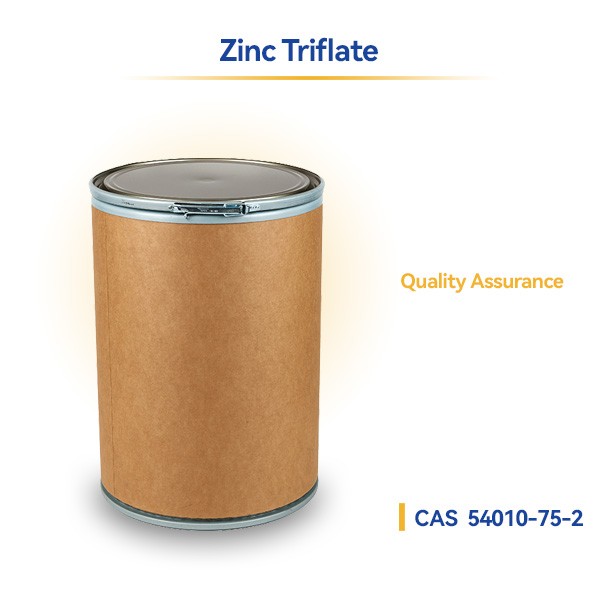
10kg, 20kg Fiber drum
Final packaging, capacity and net weight are confirmed in the quotation and order.