
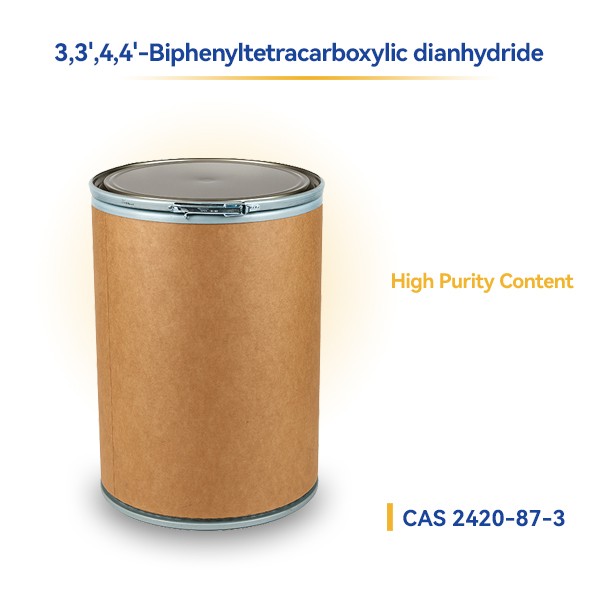
3,3',4,4'-Biphenyltetracarboxylic dianhydride (s-BPDA) CAS 2420-87-3
BPDA / s-BPDA CAS 2420-87-3 for Polyimide Synthesis
3,3′,4,4′-Biphenyltetracarboxylic dianhydride, commonly known as BPDA or s-BPDA, is a rigid aromatic dianhydride monomer with a symmetric biphenyl framework and two anhydride groups. It reacts with diamines to form polyimide precursors that can be converted into polyimides through imidization. This page covers s-BPDA CAS 2420-87-3; other BPDA structural isomers require separate identity and specification review.
BPDA belongs to Aure Chemical’s polyimide dianhydride monomers portfolio and is discussed in our Polyimide Monomers: Diamines and Dianhydrides technical guide. Aure Chemical supports China sourcing, specification review and export coordination for customers developing polyimide films, insulation materials and specialty resins. Final polymer properties depend on the formulation and processing conditions.
Basic Information of s-BPDA
| Product Name | 3,3′,4,4′-Biphenyltetracarboxylic dianhydride |
|---|---|
| Abbreviation | BPDA / s-BPDA |
| CAS Number | 2420-87-3 |
| Product Type | Symmetric biphenyl-based aromatic dianhydride monomer |
| Molecular Formula | C₁₆H₆O₆ |
| Molecular Weight | 294.22 g/mol |
| Appearance | White powder, as reported in the reference COA |
| Purity (HPLC) | ≥99.9% — reported specification; reference result shown below |
| Melting Point | ≥298 °C — reported specification; reference result shown below |
| Metal Testing | Reported limits: single metal ≤500 ppb; total metal ≤1 ppm. See the reference analysis for reporting limitations. |
| Main Application | Aromatic polyimide resin and film development, including systems designed for dimensional stability and thermal resistance |
| Package | Reference options: 1 kg/bottle or 20 kg/drum. Final packaging format and other options are subject to supplier confirmation. |
| Documents | Request the batch-specific COA and current product SDS. TDS and other technical information are subject to availability. |
| Storage Conditions | Keep in a sealed container in a dry, cool and dark place, as advised in the reference COA. Follow the current product SDS for detailed storage requirements. |
| Molecular Structure | 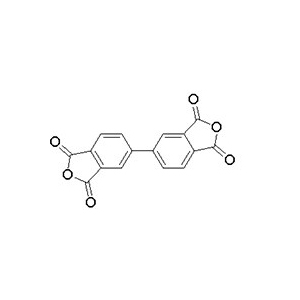 |
Reference Quality Analysis
The following data are transcribed from a supplied reference COA for s-BPDA CAS 2420-87-3. The report covers appearance, HPLC purity, melting point and two metal-control criteria. Reported specifications and reference results are shown separately.
| Test Item | Reported Specification | Reference Result |
|---|---|---|
| Appearance | White powder | White powder |
| Purity (HPLC) | ≥99.9% | 99.91% |
| Melting Point | ≥298 °C | 298.7 °C |
| Single Metal | ≤500 ppb | Approved |
| Total Metal | ≤1 ppm | Approved |
Metal results: Both results are reported as “Approved,” without numerical concentrations. The report does not identify the metals covered, the analytical method or detection limits. For applications with element-specific requirements, agree the metal panel and reporting limits before ordering. These results alone do not establish suitability for a particular electronics process.
Analytical context: HPLC is identified for purity, but the calculation basis and detailed procedure are not stated. The melting-point result is a reported temperature of 298.7 °C; the method and test conditions are not provided. Moisture, residual solvents and ionic impurities are not reported in this COA and require separate confirmation if relevant to the intended process.
These results describe one reference batch and do not guarantee the results of future deliveries. Confirm the agreed specification, required test methods and batch-specific COA for the material proposed for supply.
Key Features in Polyimide Design
Biphenyl-based backbone segment: s-BPDA is part of the polyimide dianhydride monomers family used to introduce aromatic rigidity into polymer chains.
Dimensional-stability design: Low in-plane coefficient of thermal expansion (CTE) has been demonstrated in selected s-BPDA-based polyimides. The result depends on diamine structure, chain packing, film orientation and thermal processing; it is not a fixed property of the monomer.
Purity and impurity review: HPLC purity and metal compliance provide different information. Polymer development may also require moisture control and a defined impurity profile, which should be specified separately from the reported HPLC value.
Electrical material development: BPDA-based systems are relevant to electronics and microelectronics polyimide applications. Suitability requires application-specific raw material limits and testing of the resulting polymer or film.
Processing dependence: Diamine selection, monomer stoichiometry, solvent system, imidization schedule and film formation must be evaluated together when balancing thermal, mechanical and processing requirements.
Pairing BPDA with Diamine Monomers
s-BPDA can be evaluated with products in our polyimide diamine monomers supply portfolio. Rigid aromatic diamines and ether-containing diamines offer different approaches to chain architecture. Their effects on solubility, precursor handling, chain orientation and final film properties should be assessed in the intended formulation.
Fluorinated diamines such as TFMB / TFDB CAS 341-58-2 may be screened when dielectric behavior, optical properties or moisture uptake are design targets. Ether-containing diamines such as BAPP CAS 13080-86-9 provide another structural option for evaluating flexibility and processability. The selected pairing does not by itself guarantee these outcomes.
Application Context of BPDA in Polyimide Systems
s-BPDA is supplied as a synthesis monomer. Its downstream applications depend on the properties of the resulting polyimide, the manufacturing process and qualification against the intended service conditions.
High-temperature aerospace polyimide insulation systems — development of heat-resistant insulation and specialty resin systems, subject to thermal, mechanical and application qualification of the finished material.
Electronics and microelectronics polyimide applications — formulation of insulating films and substrates where dimensional stability, electrical properties and defined contamination limits must be evaluated.
Low-CTE polyimide films and flexible substrates: Selected s-BPDA-based formulations are studied for dimensional stability during thermal processing. Film orientation and the direction and temperature range of CTE measurement are important when comparing results.
Specialty polymer research: Monomer screening and copolyimide development where aromatic rigidity, thermal behavior and processing requirements need to be balanced through formulation trials.
COA, SDS and Technical Documentation
Aure Chemical is a chemical sourcing and export supplier. We coordinate with suppliers to review product specifications, available quality documentation, packaging and international shipment requirements for s-BPDA CAS 2420-87-3. Batch-specific COA, current product SDS and available TDS information can be reviewed for the proposed supply.
Please share your required quantity, HPLC purity criterion, moisture limit, element-specific metal limits, destination country or port, preferred packaging and documentation needs. Any additional testing, packaging arrangements and shipment feasibility are confirmed with the supplier and logistics providers before order acceptance.
Contact Aure Chemical for BPDA documentation and quotation support.
Safety, Handling & Documentation
The reference hazard profile below is based on a published SDS for CAS 2420-87-3. Classification and labeling for the supplied product must be checked against its current SDS and the applicable jurisdiction.
Reference GHS classification: Skin irritation, Category 2; eye irritation, Category 2.
Signal word: Warning.
Hazard statements: H315: Causes skin irritation. H319: Causes serious eye irritation.

Control airborne powder using suitable extraction, and select gloves, eye protection and protective clothing according to the product SDS and workplace assessment. Avoid skin and eye exposure and clean up spills without dispersing dust.
The reference COA advises sealed storage in a dry, cool and dark place. Follow the current product SDS for detailed storage, incompatibility and disposal instructions. Confirm transport classification, labeling and packaging using the current SDS and shipment documentation before dispatch.
Packaging
10kg, 20kg Fiber drum
Final packaging, capacity and net weight are confirmed in the quotation and order.