
GHS Classification: Flammable Liquid (GHS02), Health Hazard (GHS08), Environmental Hazard (GHS09)
Hazard Statements: Highly flammable liquid and vapor; may cause drowsiness or dizziness; suspected of causing cancer; toxic to aquatic life with long lasting effects.
UN Number: UN 1145
Hazard Class: 3 (Flammable Liquids)
Packing Group: II
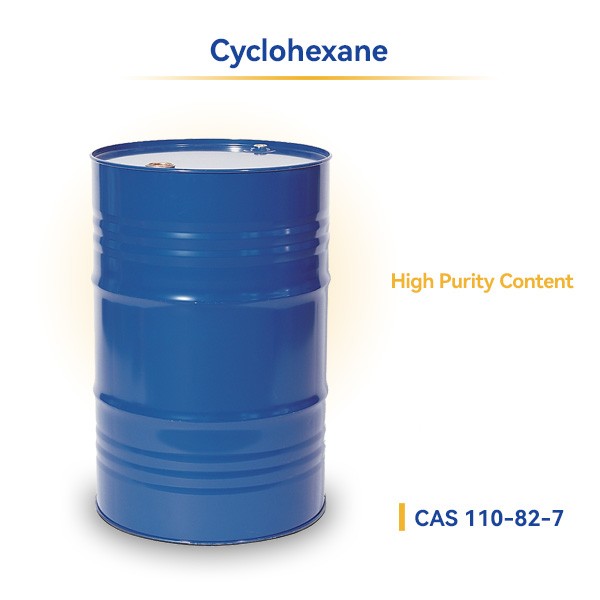
Cyclohexane CAS 110-82-7
Discover Aure Chemical's Premium Cyclohexane Supply
Aure Chemical is a leading global supplier of Cyclohexane, a key chemical building block essential for a multitude of industrial processes. We are committed to providing high-purity Cyclohexane with consistent quality and a dependable supply chain to meet your specific manufacturing demands.
Basic Information of Cyclohexane
Cyclohexane (CAS No. 110-82-7) is a colorless, non-polar, and highly flammable liquid with a distinctive, sweet odor. This cyclic alkane is primarily derived from benzene through hydrogenation or directly from petroleum fractions. Its stable ring structure makes it an invaluable solvent and an intermediate in various chemical syntheses.
| CAS No.: | 110-82-7 |
|---|---|
| EC No.: | 203-806-2 |
| Linear Formula: | C₆H₁₂ |
| Molecular Weight: | 84.16 |
| Appearance: | Transparent Liquid |
| Melting Point: | 4-7 °C (lit.) |
| Density: | 0.779 g/mL at 25 °C (lit.) |
| RIDADR: | UN 1145 3/PG 2 |
| Chemical Structure: |  |
Key Applications of Cyclohexane
Cyclohexane is a widely used industrial hydrocarbon valued for its role in nylon intermediates, solvent applications, and chemical processing. For a broader overview of hydrocarbon materials and industrial roles, refer to our industrial hydrocarbons guide.
Nylon Production: The most significant application of cyclohexane is as a precursor to adipic acid and caprolactam, key intermediates for Nylon 6 and Nylon 6,6 production. For polymer feedstock context, see hydrocarbons for polymer and chemical synthesis.
Industrial Solvent: Used as a process solvent for cellulose ethers, fats, oils, waxes, resins, and rubber where non-polar solvency and controlled evaporation are required.
Chemical Intermediates: Employed in the synthesis of important downstream chemicals such as cyclohexanol and cyclohexanone within integrated chemical production chains.
Paint and Lacquer Industry: Functions as a diluent and formulation solvent in selected coatings, lacquers, and varnish systems.
Analytical Reagent: Utilized in laboratory and quality control environments as a reference solvent and for various analytical procedures.
Frequently Asked Questions (FAQ)
What is Cyclohexane (CAS 110-82-7)?
Cyclohexane is a colorless, flammable liquid hydrocarbon with the molecular formula C₆H₁₂. It is widely used as a solvent and an intermediate in the production of nylon, paints, adhesives, and coatings.
What are the main applications of Cyclohexane?
The major application of cyclohexane is in the production of adipic acid and caprolactam, which are key intermediates for nylon-6 and nylon-6,6. It is also used as an industrial solvent in paints, coatings, degreasing, adhesives, and chemical synthesis.
Why is chloroacetic acid stronger than acetic acid?
The electronegative chlorine atom exerts an inductive effect, stabilizing the conjugate base and making proton donation easier.
Is Cyclohexane aromatic?
No. Cyclohexane is a non-aromatic hydrocarbon. Although it has a six-membered ring structure, it lacks the delocalized π-electron system required for aromaticity (as found in benzene).
Is Cyclohexane polar or nonpolar?
Cyclohexane is nonpolar. Its carbon-hydrogen bonds have very small differences in electronegativity, and the molecule is symmetrical, so there is no permanent dipole moment.
Is Cyclohexane polar?
No, cyclohexane is not polar. This is why it dissolves well in nonpolar organic solvents (like benzene, toluene, hexane) but is almost insoluble in water.
Is Cyclohexane hazardous?
Yes. Cyclohexane is classified as a flammable liquid (GHS02) and can cause drowsiness or dizziness upon inhalation. Long-term exposure may pose health risks, and it is toxic to aquatic organisms. Proper handling, PPE, and ventilation are essential.
Is Cyclohexane soluble in water?
Cyclohexane is practically insoluble in water (less than 0.01 g/100 mL at room temperature) but is miscible with many organic solvents such as acetone, ethanol, ether, and benzene.
How should Cyclohexane be stored?
Store in tightly sealed containers in a cool, dry, and well-ventilated area.
Keep away from heat, sparks, and open flames.
Use proper grounding to prevent static discharge.
Store separately from oxidizers and acids.
What packaging options are available for Cyclohexane?
Cyclohexane is typically supplied in:
Metal drums (160–200 L)
ISO tanks or IBC containers (bulk supply)
Smaller lab-grade bottles for analytical or research use
Can Aure Chemical supply bulk Cyclohexane?
Yes. Aure Chemical offers high-purity Cyclohexane with flexible packaging options, including bulk drums and ISO tanks, supported by global logistics to meet industrial demand.
Aure Chemical: Your Trusted Cyclohexane Supplier
Partnering with Aure Chemical for your Cyclohexane needs means benefiting from:
Reliable Global Logistics: We leverage an extensive network to ensure efficient and secure delivery of Cyclohexane to customers worldwide, adhering to all international shipping regulations.
Rigorous Quality Assurance: Our products undergo thorough quality control processes, guaranteeing consistent purity and performance across every batch.
Commitment to Safety: We strictly follow international guidelines for the safe handling, storage, and transportation of Cyclohexane, providing complete Safety Data Sheets (SDS) and necessary dangerous goods documentation.
Expert Customer Support: Our knowledgeable team is always available to provide technical insights and assist with your ordering and logistical requirements.
Hazards Classification



Related Articles
Packaging, Logistics & Compliance Capabilities
Aure Chemical provides flexible packaging solutions, compliant logistics arrangements, and controlled storage practices to support laboratory-scale, pilot-scale, and commercial-scale global supply.
Packaging Options
- 25 kg / 50 kg bags (fiber drum, aluminum bag, HDPE drum)
- 100 kg / 200 kg steel or HDPE drums
- 500 kg / 1000 kg IBC containers
- Bulk liquids in ISO tank containers
- Customized packaging upon request
Transportation Modes
- Sea freight (FCL / LCL)
- Air freight for selected products
- Road and rail transportation
- Dangerous & non-dangerous cargo handling
- Incoterms: EXW, FOB, CFR, CIF, DAP, DDP
Storage & Handling
- Dry, cool, and well-ventilated warehouses
- Segregation by hazard class
- FIFO inventory management
- Temperature-controlled storage if required
- Regular inspection & labeling control
Documentation & Compliance
- Safety Data Sheet (SDS)
- Certificate of Analysis (COA)
- Dangerous Goods Declaration (DGD)
- Packing List & Commercial Invoice
- IMDG / IATA / ADR compliant labeling
For packaging customization or logistics consultation, please contact us.
INQUIRY