
Reference GHS classification: Flammable liquid, Category 3; acute toxicity, Category 3 (dermal and inhalation) and Category 4 (oral); skin corrosion, Category 1B; and serious eye damage, Category 1. Signal word: Danger.
Hazard summary: Flammable and harmful by ingestion, with toxicity through skin contact and inhalation and a risk of severe skin and eye injury. Prevent vapor exposure and direct contact.
Handling and storage: Provide effective ventilation and control ignition sources and static discharge. Select chemical-resistant gloves, protective clothing, eye and face protection, and any respiratory protection according to the SDS and workplace assessment. Store securely closed in a cool, dry, well-ventilated location, separated from incompatible materials specified in the SDS.
Transport reference: UN 2313, PICOLINES; Class 3 (flammable liquid); Packing Group III. Confirm the product-specific requirements for the transport mode and destination before shipment.
3-Picoline CAS 108-99-6
Discover Aure Chemical's High-Purity 3-Picoline (CAS 108-99-6) Supply
3-Picoline (β-picoline or 3-methylpyridine), CAS 108-99-6, is a pyridine derivative with a methyl group at the 3-position relative to the ring nitrogen. It is an industrial intermediate in vitamin B3 production and in selected agrochemical, pharmaceutical intermediate, and fine chemical synthesis routes. Aure Chemical supports China sourcing, specification review, quality documentation, and international export coordination for 3-picoline.
Basic Information of 3-Picoline
The following table identifies 3-picoline and gives general physical reference data. Batch-specific composition, appearance, and water results are presented separately in the Reference Quality Analysis section.
| CAS No.: | 108-99-6 |
|---|---|
| EC No.: | 203-636-9 |
| Molecular Formula: | C₆H₇N |
| Molecular Weight: | 93.13 g/mol |
| Appearance: | Colorless or light-yellow liquid; the reference batch is reported as a light yellow liquid |
| Odor: | Characteristic, sweetish odor (published reference) |
| Melting Point: | −19 °C (literature reference) |
| Boiling Point: | 144 °C (literature reference) |
| Density: | 0.957 g/mL at 25 °C (literature reference) |
| Water Solubility: | Reported as soluble in the reference COA water-mixing test |
| Flash Point: | 37 °C, closed cup (published reference; not a batch test result) |
| Chemical Type: | Methyl-substituted pyridine; nitrogen-containing heterocyclic base |
| Transport Reference: | UN 2313, PICOLINES; Class 3; Packing Group III. Confirm the applicable classification using the current product SDS and shipment documents. |
| Chemical Structure: | 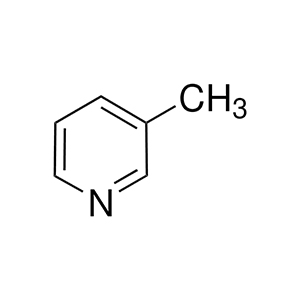 |
Reference Quality Analysis
The following analysis provides a technical reference for evaluating 3-picoline with a reported 99% specification. In addition to β-picoline content and water, the report controls γ-picoline, the 4-methylpyridine isomer. The separate isomer result is relevant when reviewing feedstock composition for downstream synthesis.
| Test Item | Reported Specification | Reference Result |
|---|---|---|
| Appearance | Colorless or light-yellow liquid | Light yellow liquid |
| β-Picoline content (%) | ≥99.0 | 99.31 |
| γ-Picoline content (%) | ≤0.6 | 0.44 |
| Mixing with water | Soluble | Soluble |
| Water content (%) | ≤0.1 | 0.01 |
The report does not state analytical methods, the percentage basis, or the water-mixing test conditions. The listed γ-picoline value is an individual impurity result, not a measure of total impurities. Additional isomer limits or related-substance testing should be agreed separately if required.
These values represent one reference batch and are provided for preliminary technical evaluation. They should not be interpreted as guaranteed specifications or results for every shipment. Confirm the applicable quality requirements and request a current, batch-specific Certificate of Analysis (COA) before ordering.
Primary Applications of 3-Picoline (β-Picoline)
3-Picoline is supplied as a chemical intermediate. Suitability for a particular manufacturing route depends on the agreed specification and process requirements; use in a vitamin or pharmaceutical synthesis chain does not establish a finished food, feed, or pharmaceutical grade for this material.
Niacin and niacinamide production: Oxidation of the methyl group can produce nicotinic acid, also known as niacin, a form of vitamin B3. β-Picoline is also a starting material in the niacinamide manufacturing chain. Niacinamide, or nicotinamide, is the corresponding amide and is a distinct compound.
Agrochemical intermediates: Used in selected routes to pyridine-containing crop protection intermediates. Confirm the required isomer composition and impurity limits for the intended route rather than treating all picoline isomers as equivalent feedstocks.
Pharmaceutical intermediate synthesis: Used in selected synthesis routes requiring a 3-substituted pyridine building block. Any additional analytical or quality documentation requirements should be defined for the specific process.
Fine chemical derivatives: Used as a starting material for further pyridine chemistry, including derivatives of nicotinic acid and other specialty intermediates. The appropriate transformation depends on the target structure and process conditions.
Specialty solvent and reagent: Used as a solvent or basic reagent in selected organic processes, including certain dye and pharmaceutical intermediate operations. Compatibility, recovery, and residual solvent requirements need process-specific evaluation.
Why Choose Aure Chemical for Your 3-Picoline Supply?
Aure Chemical is a chemical sourcing, trading, and export supply company. We coordinate supplier information and documentation to support buyers reviewing 3-picoline for industrial synthesis.
Specification review: Review β-picoline content, γ-picoline limit, water, appearance, and any additional buyer requirements against the available quality documentation.
Quality documentation: Coordinate the batch COA and current product SDS. Test methods and any additional isomer or impurity analysis should be confirmed before purchase.
Supplier coordination: Confirm grade, quantity, packaging, and lead time for the proposed order. The displayed reference analysis does not establish the results of future supply batches.
Export and logistics coordination: Review dangerous goods packaging, labeling, shipment documentation, route availability, and destination requirements before confirming transport arrangements.
Safety, Handling & Documentation
The following summary reflects published reference safety information for 3-picoline. Use the current SDS for the supplied product to confirm the complete hazard classification, required protective measures, and applicable labeling and transport arrangements.



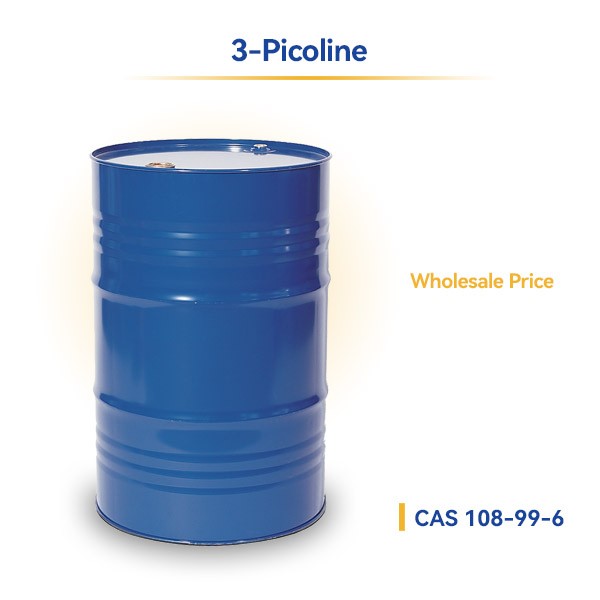
Packaging
200 L steel drum
Final packaging, capacity and net weight are confirmed in the quotation and order.