

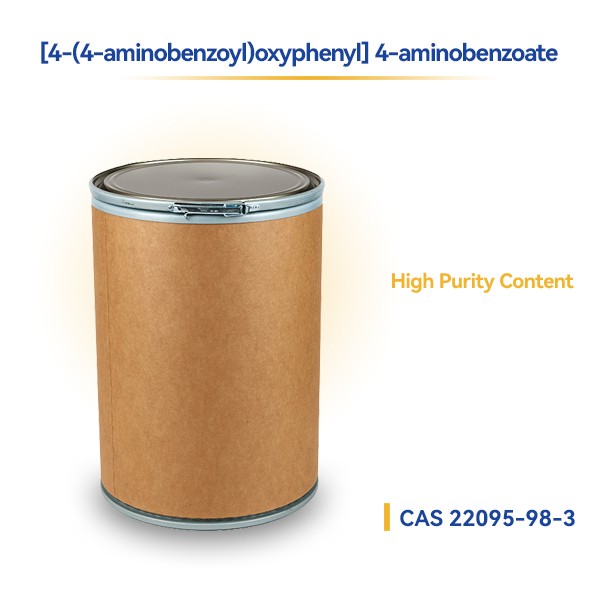
[4-(4-aminobenzoyl)oxyphenyl] 4-aminobenzoate (ABHQ) CAS 22095-98-3
ABHQ CAS 22095-98-3 for Polyimide and Specialty Polymer Synthesis
ABHQ (CAS 22095-98-3), also known as 1,4-phenylene bis(4-aminobenzoate) or hydroquinone bis(4-aminobenzoate), is an ester-containing aromatic diamine monomer for polyimide and specialty polymer synthesis. Its structure contains three aromatic rings, two terminal primary amino groups, and two ester linkages connecting the aminobenzoate units to the central hydroquinone-derived ring. In suitable diamine–dianhydride polymerization routes, it introduces ester-containing segments into a poly(ester-imide) backbone.
ABHQ belongs to the broader category of polyimide diamine monomers. Aure Chemical supports China sourcing, specification review, quality documentation, and export coordination for this non-fluorinated diamine. Selection should consider HPLC purity, moisture, reaction-medium compatibility, and the requirements of the intended polymer formulation.
Basic Information of ABHQ
| Product Name | [4-(4-aminobenzoyl)oxyphenyl] 4-aminobenzoate |
|---|---|
| Common Name | 1,4-Phenylene bis(4-aminobenzoate); hydroquinone bis(4-aminobenzoate) |
| Abbreviation | ABHQ |
| CAS Number | 22095-98-3 |
| Product Type | Aromatic diamine monomer with ester linkages |
| Molecular Formula | C₂₀H₁₆N₂O₄ |
| Molecular Weight | 348.35 g/mol |
| Appearance | Off-white powder (reported specification) |
| Purity (HPLC) | Reported specification: ≥99.5% by HPLC; see Reference Quality Analysis for the reference batch result |
| Moisture | Reported specification: ≤0.05%; see Reference Quality Analysis for the reference batch result |
| Main Application | Poly(ester-imide) synthesis and specialty aromatic polymer development |
| Package | Reference options: 1 kg/bottle or 20 kg/drum; availability and alternative packaging to be confirmed for each order |
| Documents | Available COA, SDS and TDS can be reviewed for the proposed grade; request the applicable batch-specific COA before ordering |
| Storage Reference | The report recommends a sealed container and dry storage in a cool, dark place. Confirm the applicable requirements using the current product SDS. |
| Molecular Structure | 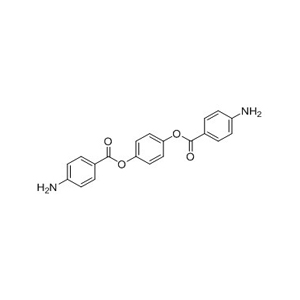 |
Reference Quality Analysis
The following appearance, HPLC purity, and moisture parameters provide a technical reference for evaluating ABHQ as an ester-containing aromatic diamine. Purity and moisture are relevant to monomer acceptance for condensation polymerization, while polymerization behavior must be evaluated in the chosen formulation.
| Test Item | Reported Specification | Reference Result |
|---|---|---|
| Appearance | Off-white powder | Off-white powder |
| Purity (HPLC), % | ≥99.5 | 99.68 |
| Moisture, % | ≤0.05 | 0.04 |
The report identifies HPLC as the purity method but does not specify the chromatographic procedure or percentage calculation basis. The moisture test method is not stated. Residual solvent, trace metal, and ionic impurity results are not reported; any such requirements should be confirmed separately.
These analytical values describe one reference batch and are provided for preliminary technical evaluation. They should not be interpreted as guaranteed values for every shipment. Contact Aure Chemical to confirm the applicable quality requirements and request the relevant batch-specific Certificate of Analysis (COA) before ordering.
Key Features in Polymer Design
Aromatic diamine functionality: The two primary aromatic amino groups provide sites for condensation reactions with suitable comonomers. Reaction stoichiometry and functional-group balance are important when developing high-molecular-weight polymers.
Ester-containing backbone design: The two ester linkages distinguish ABHQ from aromatic diamines containing only direct carbon–carbon or ether connections. Their influence on chain packing, processing, and durability depends on the complete polymer structure and use conditions.
ABHQ can be evaluated in specialty functional polyimide development when ester-containing aromatic segments are required in the polymer backbone.
For high-temperature polyimide applications, thermal stability, dimensional behavior, and mechanical properties must be measured in the final material. Monomer identity and purity alone do not establish application qualification.
Final material properties depend on monomer quality, dianhydride selection, solvent system, stoichiometry, imidization conditions, and polymer processing. HPLC purity and moisture measurements do not replace formulation or film testing.
Pairing ABHQ with Dianhydride Monomers
In polyimide route development, ABHQ may be evaluated with selected polyimide dianhydride monomers. Aromatic dianhydrides such as BPDA CAS 2420-87-3 or BTDA CAS 2421-28-5, and ether-containing dianhydrides such as ODPA CAS 1823-59-2, offer different structural options for formulation screening.
Each diamine–dianhydride combination requires assessment of monomer dissolution, polymerization behavior, imidization, and film formation. Thermal expansion, strength, optical transmission, and processability should be established for the resulting polymer rather than inferred from the monomer pair alone.
Application Context of ABHQ in Polyimide Systems
ABHQ is a structural monomer for developing ester-containing polyimide resins and films. Its aromatic segments and ester linkages are variables in polymer design; suitability for a specific coating, film, or engineered component requires formulation and performance evaluation.
Specialty functional polyimide development – selection of ester-containing diamine units for specialty polymer structures.
Flexible and processable polyimide applications – evaluation of reaction-medium compatibility, solution behavior, and film processing.
High-temperature polyimide applications – review of thermal, dimensional, and mechanical qualification requirements for the intended use.
Transparent and optical polyimide materials – comparison of optical requirements, with coloration, transmission, and haze assessed in the finished film.
COA, SDS and Technical Documentation
Aure Chemical is a chemical trading and export supply company supporting product specification review, supplier coordination, quality documentation, and international logistics for ABHQ CAS 22095-98-3. Available COA, SDS and TDS documents can be reviewed for the proposed grade. Confirm the agreed specification, packaging, and batch documentation before ordering.
Please share the required purity, target specification, quantity, destination country or port, preferred packaging method and required documents so we can review availability, documentation support and export packing options.
Contact Aure Chemical for ABHQ documentation and quotation support.
Safety, Handling & Documentation
Published reference SDS for ABHQ CAS 22095-98-3 include the hazard information below. Classifications can differ between supplier documents and jurisdictions; confirm the applicable classification and labeling using the current SDS for the supplied grade and destination.
Reference GHS Classification: Acute toxicity, oral, Category 4; skin irritation, Category 2; eye irritation, Category 2A.
Hazard Statements: H302: Harmful if swallowed. H315: Causes skin irritation. H319: Causes serious eye irritation.
Signal Word: Warning.

Minimize dust formation and avoid inhalation, ingestion, and contact with skin and eyes. Use suitable ventilation, protective gloves, clothing, and eye protection as specified by the current SDS and workplace assessment. Follow the confirmed storage instructions, keeping the container sealed and the material dry, cool, and protected from light.
Confirm transport classification, packaging, and labeling for the actual shipment using the current product SDS and relevant shipment documentation. The reference COA records quality test results and storage advice; it does not replace the SDS.
Packaging
10kg, 20kg Fiber drum
Final packaging, capacity and net weight are confirmed in the quotation and order.
-
2,2-Bis[4-(p-aminophenoxy)phenyl]hexafluoropropane (HFBAPP) CAS 69563-88-8
-
2,2-Bis(3-amino-4-hydroxylphenyl)propane (BAP) CAS 1220-78-6
-
-
-
2,2'-Bis(trifluoromethyl)-4,4'-diaminodiphenyl ether (6FODA) CAS 344-48-9
-
4-Aminobenzoic acid 4-aminophenyl ester (APAB) CAS 20610-77-9
-
4,4'-Bis(3-aminophenoxy)diphenyl sulfone (M-BAPS) CAS 30203-11-3