
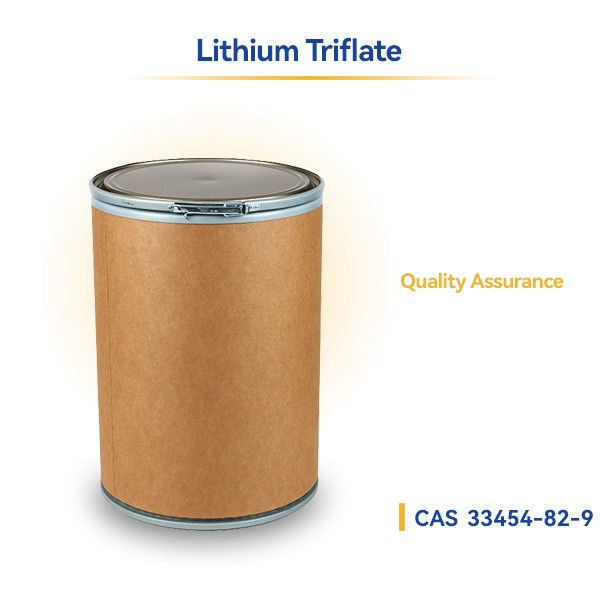
Lithium Triflate CAS 33454-82-9
Lithium Triflate (Lithium Trifluoromethanesulfonate), CAS 33454-82-9, from Aure Chemical
Lithium triflate, also known as lithium trifluoromethanesulfonate or LiOTf, CAS 33454-82-9, is a lithium salt comprising lithium cations and trifluoromethanesulfonate anions. It is used in selected liquid and polymer electrolyte formulations and as a catalyst in specific organic synthesis reactions. Aure Chemical supports China sourcing and international export supply of lithium triflate, with specification review and quality documentation coordinated for the intended application.
Basic Information of Lithium Triflate
Product identity and reference properties are summarized below. The batch analysis in the following section provides separate information on purity, water content, solution color, and measured impurities.
| CAS No. | 33454-82-9 |
|---|---|
| EC No. | 251-528-5 |
| Chemical Formula | CF₃SO₃Li |
| Molecular Weight | 156.01 g/mol |
| Appearance | White powder |
| Melting Point | >300 °C (reference value) |
| Solubility | Soluble in water |
| Moisture Sensitivity | Hygroscopic; protect from moisture in accordance with the applicable SDS and packaging instructions. |
| Chemical Structure | 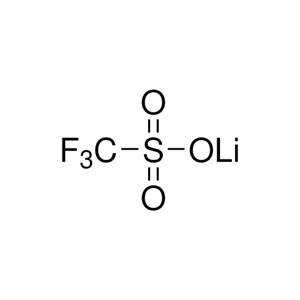 |
Reference physical properties do not establish electrolyte performance. Suitability for a particular battery chemistry, polymer matrix, or synthetic process requires evaluation of the complete formulation and the applicable product specification.
Reference Quality Analysis
The following quality parameters provide a technical reference for evaluating lithium triflate, including purity, water content, color of an aqueous solution, trace metals, chloride, and sulfate. Reported specifications and results are reproduced from one reference batch analysis.
Physical and Chemical Quality Parameters
| Test Item | Reported Specification | Reference Result |
|---|---|---|
| Appearance | White powder | White powder |
| Water Content | ≤ 200 ppm | 36.6 ppm |
| Purity | ≥ 99.9 wt% | 99.99 wt% |
| Color (10% Aqueous Solution) | ≤ 30 APHA | 5 APHA |
Trace Metal Analysis
| Test Item | Reported Specification | Reference Result |
|---|---|---|
| Potassium (K) | ≤ 5 ppm | 0.1 ppm |
| Sodium (Na) | ≤ 10 ppm | 0.7 ppm |
| Iron (Fe) | ≤ 2 ppm | 0.4 ppm |
| Calcium (Ca) | ≤ 5 ppm | 0.1 ppm |
| Nickel (Ni) | ≤ 1 ppm | ND |
| Chromium (Cr) | ≤ 1 ppm | 0.3 ppm |
Anionic Impurity Analysis
| Test Item | Reported Specification | Reference Result |
|---|---|---|
| Chloride (Cl⁻) | ≤ 10 ppm | 0.5 ppm |
| Sulfate (SO₄²⁻) | ≤ 40 ppm | 5 ppm |
ND means not detected; the detection limit is not stated in the reference COA. The report specifies a 10% aqueous solution for color testing without identifying the concentration basis. Analytical methods are not stated in the report.
These values describe one reference batch and are provided for preliminary technical evaluation. They should not be interpreted as guaranteed specifications for every shipment. Confirm the applicable purity, moisture and impurity limits with Aure Chemical and request the relevant batch-specific Certificate of Analysis (COA) before ordering. The reported analysis alone does not establish suitability for a particular battery or other sensitive application.
Primary Applications of Lithium Triflate (Lithium Trifluoromethanesulfonate)
Lithium triflate is evaluated as a lithium-ion source in electrolyte systems and as a catalyst in documented synthetic transformations. Performance depends on the solvent or polymer, concentration, operating conditions, and compatibility with other components.
Liquid Electrolyte Formulation: Used as a lithium salt in selected electrolyte formulations and battery research. Solubility, ionic conductivity, electrochemical stability, and electrode compatibility need to be measured in the intended solvent system; they cannot be inferred from salt purity alone.
Polymer Electrolyte Development: Incorporated into polymer hosts such as poly(ethylene oxide) in studies of solid and composite polymer electrolytes. Salt concentration, polymer structure, water content, additives, and temperature affect ion transport and material properties.
Supercapacitor Materials Research: Investigated as a salt component in ion-conducting polymer and composite systems for supercapacitor applications. Device suitability depends on the full electrolyte, separator, and electrode system.
Catalyst in Organic Synthesis: Published applications include catalysis of alcohol acetylation and conversion of aldehydes to 1,1-diacetates. Selection and loading should follow the validated reaction procedure and substrate requirements.
Its role as an electrolyte salt is discussed in TFSI and triflate salts in electrochemistry.
Aure Chemical: Lithium Triflate Sourcing and Export Support
Aure Chemical is a chemical trading and export supply company. For lithium triflate procurement, we support review of product requirements and coordination with suppliers for the agreed grade, quantity, packaging, and destination.
Specification Review: Review purity, water content, trace metal limits, and anionic impurities against the customer's purchasing requirements. Additional testing requirements should be agreed before ordering.
Quality Documentation: Coordinate the relevant batch COA and available SDS. Analytical methods, detection limits, and any application-specific documentation can be requested for confirmation where needed.
Supplier and Packaging Coordination: Discuss available pack sizes and moisture-protective packaging with the supplier. Availability and lead time are confirmed for the specific inquiry.
International Export Logistics: Coordinate labeling, shipping documents, and transport arrangements according to the supplied product's SDS, order terms, carrier requirements, and destination rules.
Safety, Handling & Documentation
The available lithium triflate SDS identifies skin and eye irritation and potential respiratory irritation. Avoid dust generation, inhalation, and skin or eye contact. Use suitable ventilation and personal protective equipment as specified by the applicable SDS and workplace risk assessment.
Lithium triflate is hygroscopic. Keep containers tightly closed and protect the material from moisture under the storage conditions specified for the supplied grade. Exposure during weighing, transfer, and repacking can affect water content, which is relevant when evaluating the material for moisture-sensitive electrolyte formulations.
Consult the applicable SDS for storage conditions, incompatibilities, emergency measures, disposal, and transport classification. Confirm the latest available revision and its applicability to the ordered grade and destination before handling or shipment.
Related Articles
For context on how lithium triflate relates to triflate salts and related systems, see the overview of triflic acid and triflate chemistry.
Download Lithium Triflate SDS
Review the available Safety Data Sheet for Lithium Triflate (CAS 33454-82-9) for hazard information, first aid measures, handling precautions, and personal protective equipment recommendations.
 Lithium Triflate SDS (PDF)
Confirm that the SDS revision applies to the supplied grade and destination. Keep the applicable document accessible to personnel handling the product.
Packaging
10kg, 20kg Fiber drum
Final packaging, capacity and net weight are confirmed in the quotation and order.